

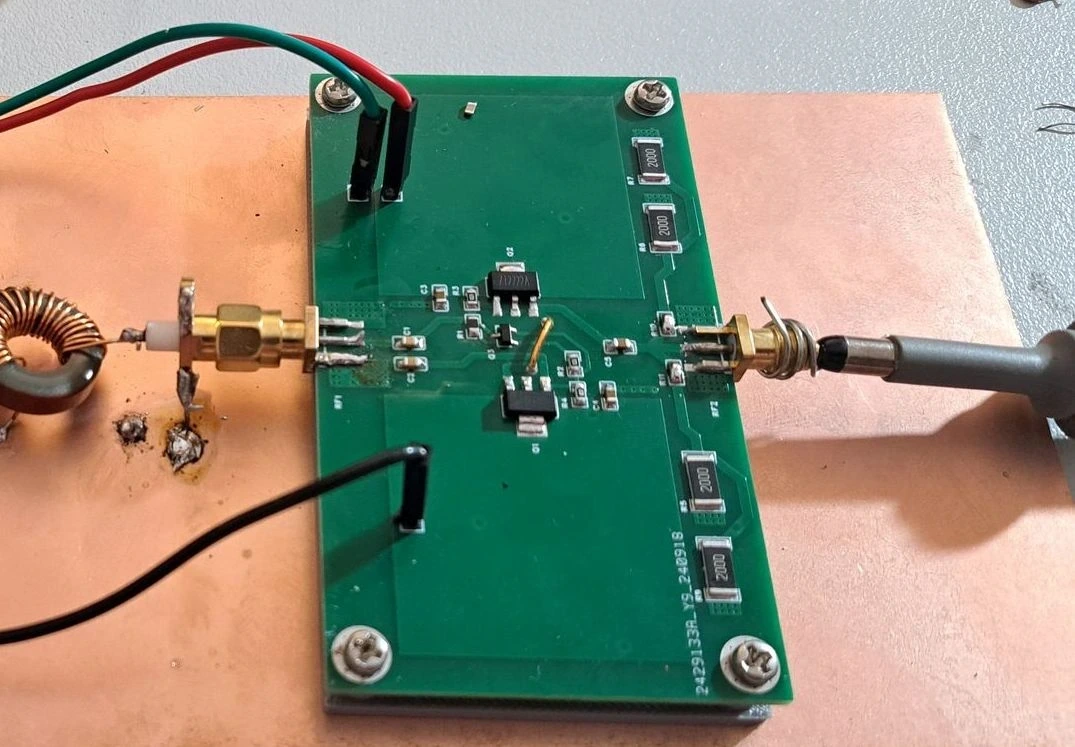
 Completed
SOT-223 LBA – Linear Buffer Amplifier
PROSOT-223 LBA – Linear Buffer Amplifier
License
:BSD License
Description
SOT-223 LBA – Linear Buffer Amplifier
The SOT-223 LBA is a compact, wideband class AB RF buffer module designed for experimentation, prototyping, and educational use. It leverages inexpensive, readily available SOT-223 transistors (e.g., 2N2222 and its complement) to provide a hands-on platform for exploring transistor behavior, gate/base drive characteristics, and linear amplification in the HF band.
Features
-
Class AB linear buffer using two SOT-223 transistors
-
Wide bandwidth: ~1–20 MHz with simple components
-
Output power: ~1.5 W typical
-
Optional input matching network: tunable series capacitor + shunt inductor for HF optimization
-
SMA edge-mount connectors for easy input/output interfacing
-
Support for 4W 50 Ω dummy load for convenient power measurements and scope monitoring
-
Versatile experimentation: suitable for:
-
Small QRSS or QRSP transmitter setups
-
Antenna and matching experiments
-
RF transistor characterization
-
Educational lab exercises
-
Design Goals
-
Hands-on learning: Observe real transistor behavior and switching speed
-
Prototyping flexibility: Leave pads open or populate optional components to experiment with different matching networks
-
Open-source friendly: All design files, schematics, and layout are intended for community experimentation and adaptation
Typical Applications
-
HF linear amplification testing
-
RF input matching exploration
-
Small signal QRSS transmitter experiments
-
VNA-based measurements and tuning exercises
The SOT-223 LBA is ideal for hobbyists, educators, and RF enthusiasts who want a compact, low-cost, and flexible platform for understanding transistor linearity and HF signal behavior.
Design Drawing
 The preview image was not generated, please save it again in the editor.
BOM
 Bom empty
 Clone
CloneProject Members

Intellectual Property Statement & Reproduction Instructions
This is an open-source hardware project. All intellectual property rights belong to the creator. The project is shared on the platform for learning, communication, and research only; any commercial use is prohibited. If your intellectual property rights are infringed on EasyEDA, please notify us by submitting relevant materials in accordance with the Rules for Complaints and Appeals of IPR Infringement.
Users must independently verify the circuit design and suitability when replicating this project. All risks and consequences are borne by the user, and the platform assumes no liability.
 Empty
Empty
Comment